Research

We develop theory and computational methods to understand how electrons and nuclei respond to light, move together, and give rise to the properties of matter.

Light-driven quantum dynamics

We use time-dependent density functional theory to follow electronic excitations, charge transfer, and relaxation in molecules and solids. Applications range from ultrafast processes in quantum materials to photocatalytic water splitting.

Electric field (normalized)

10−1 02467.5 fs
Simulation time0.0 fs
Magnetization magnitude
00.050.1
Laser-driven spin dynamics in a chromium monolayer. Color and arrows show the magnitude and direction of the local spin magnetization. The normalized field curve is fitted to the electric-field indicator shown in E. K. U. Gross’s lecture.

Coupled electron–nuclear motion

We develop approaches based on exact factorization and path integrals to describe coupled electron–nuclear motion beyond the Born–Oppenheimer approximation. We study how nuclear quantum effects and nonadiabatic transitions influence excited-state dynamics.

Photoexcitation and wave-packet splitting. A light pulse excites the system at fixed nuclear geometry. Near the avoided crossing, two branches continue to the right, one on each surface, while a small branch reflects to the left on the ground-state surface.

Many-body behavior

We study how correlations among electrons give rise to collective behavior and shape the properties of quantum materials.
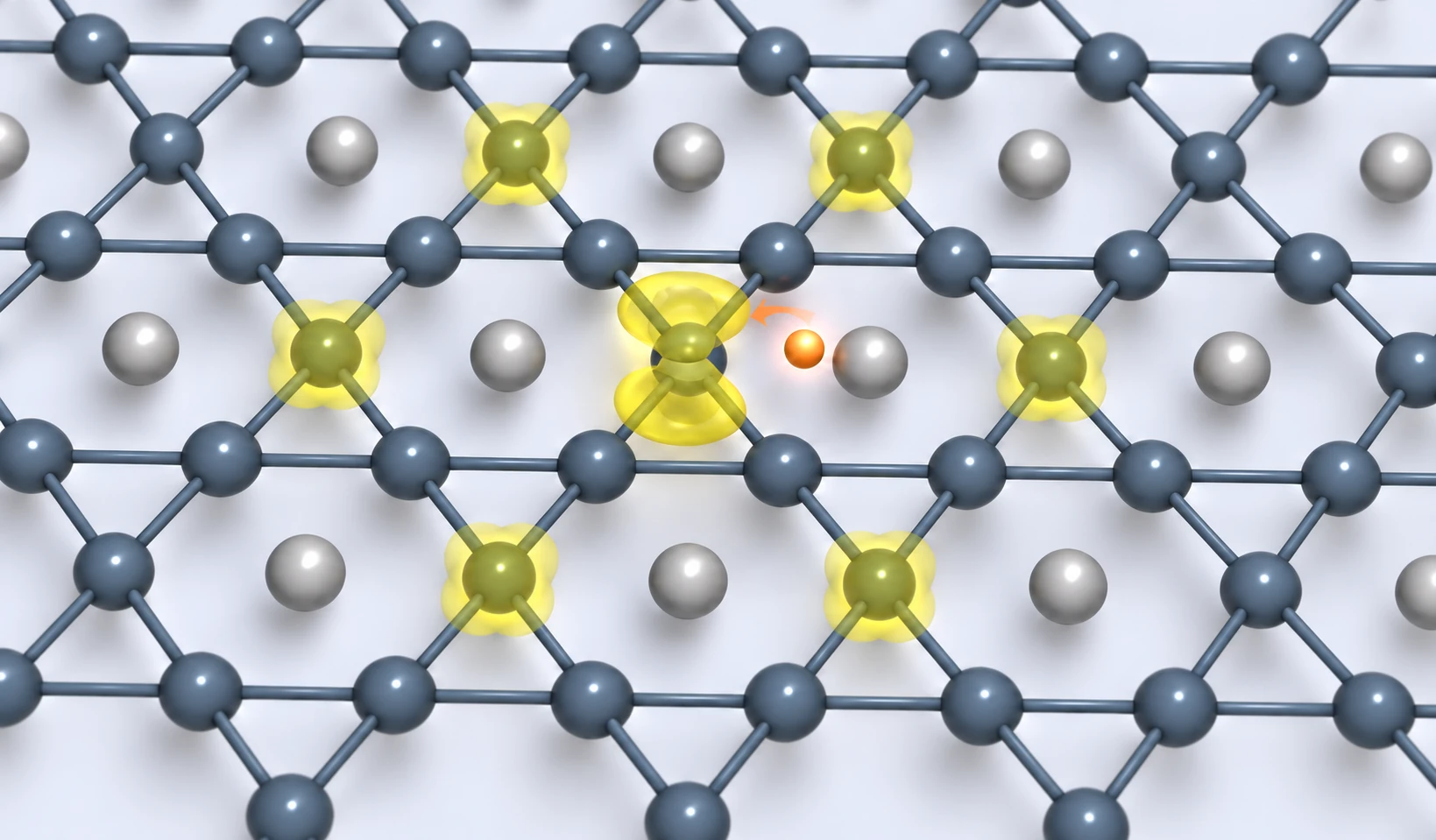
Cover illustration of a crystal lattice with an orange reference electron and translucent yellow density lobes on nearby sites.
Many-body correlations. Cover illustration of how the distribution of electrons around a reference electron can vary across a crystal lattice.